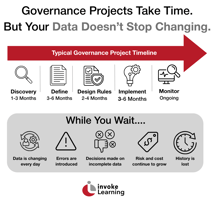
You Can’t Govern What You Can’t See: Why Data Snapshotting Comes First Data governance is a top...
Higher education leaders are often told they face a painful trade-off:
Cut costs to survive shrinking budgets.
Or invest in student success to improve retention and completion.
But this is a false choice.
Institutions that modernize their data infrastructure are proving that financial discipline and student success can reinforce each other. The key isn’t choosing one priority over the other. It’s fixing the foundation that supports both.
The Real Problem Isn’t Funding — It’s Fragmentation
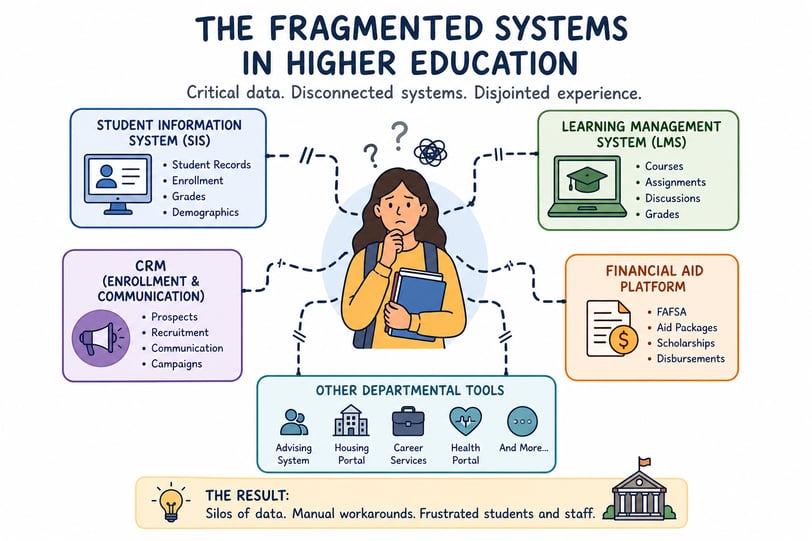 Most colleges and universities operate with a complex ecosystem of systems:
- Student Information Systems
- Learning Management Systems
- CRMs
- Financial aid platforms
- Departmental tools
Individually, these systems work. Together, they rarely do.
Data is copied into warehouses, reshaped through custom ETL processes, and rebuilt for every new reporting need. Historical data is inconsistent. Definitions vary by department. Analytics teams spend more time reconciling numbers than delivering insight.
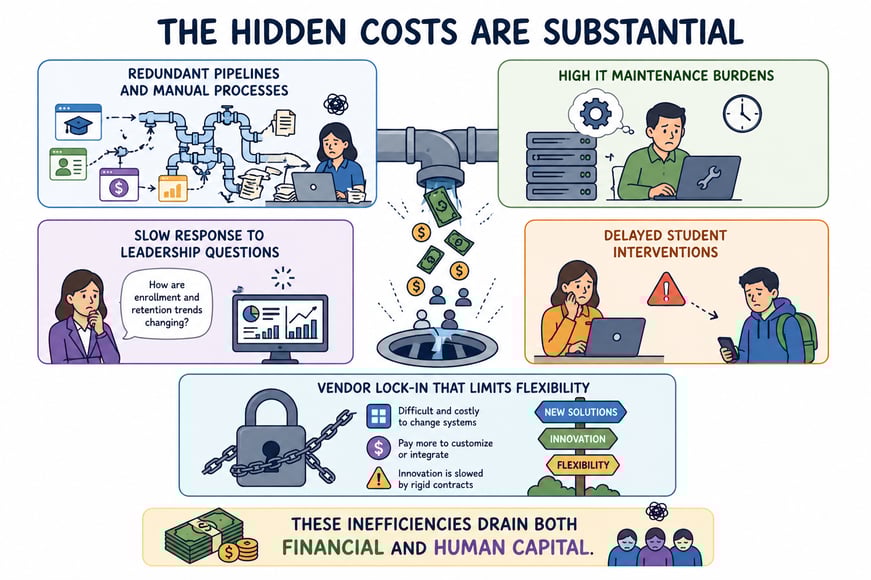
The hidden costs are substantial:
- Redundant pipelines and manual processes
- High IT maintenance burdens
- Slow response to leadership questions
- Delayed student interventions
- Vendor lock-in that limits flexibility
These inefficiencies drain both financial and human capital.
Why Infrastructure Determines Outcomes
When institutions rely on fragmented data, student success initiatives struggle to scale.
Advisors don’t see a complete picture of the student.
Institutional research teams are buried in one-off data pulls.
Leaders make high-stakes decisions without longitudinal context.
Even strong programs—early alerts, targeted outreach, equity initiatives—lose impact when the data underneath them is incomplete or unreliable.
Modern data architecture changes that.
A unified, historized data foundation built for higher education consolidates integration, analytics, and governance into a single environment. Instead of rebuilding pipelines for every initiative, institutions build once and reuse everywhere.
The result is lower operational cost and higher institutional agility.
Cost Reduction Through Modernization
A modern lakehouse approach reduces expenses in practical ways:
Lower IT Maintenance
Automated daily loads, standardized data models, and cloud portability reduce the need for custom scripts and manual intervention. IT teams shift from maintaining fragile pipelines to supporting innovation.
Fewer Redundant Efforts
When data is consistent and historically tracked, institutional research and analytics teams don’t have to recreate reports for every department. Trend analysis across time becomes straightforward.
Reduced Rework
When governance rules change, they can be applied retroactively without rebuilding infrastructure. That flexibility prevents costly redevelopment cycles.
Infrastructure efficiency directly translates into budget efficiency.
Student Success Improves When Data Improves
Student success is often treated as a programming challenge. But it’s fundamentally a data challenge.
When academic, financial, and engagement data are unified:
- Risk indicators become more accurate.
- Interventions happen earlier.
- Leaders can track cohort and equity trends over time.
Instead of reacting to problems after the term ends, institutions act while outcomes can still change.
Even a 1–2% improvement in retention can represent millions in preserved tuition revenue at a mid-sized institution. That’s not just a student success win—it’s a financial strategy.
Better data leads to better decisions. Better decisions lead to stronger retention. Stronger retention stabilizes revenue.
Governance as a Cost Saver, Not a Cost Center
Data governance is often viewed as compliance overhead. In reality, it reduces institutional risk and waste.
When every piece of data is historized and accessible:
- Reporting errors decrease.
- Audit preparation becomes easier.
- Departments align around consistent definitions.
- Leadership trusts the numbers in front of them.
Governance done right reduces duplication, reconciliation work, and reputational risk.
AI Without Rebuilding Everything
Many institutions are exploring AI to support advising, enrollment strategy, and operational efficiency. But AI depends on clean, integrated, historical data.
Without the right foundation, AI becomes another disconnected tool.
With unified infrastructure, AI can leverage multi-source data, analyze longitudinal trends, and provide context-rich recommendations. Institutions don’t have to rebuild their environment to adopt emerging capabilities—they simply activate them.
That protects both budget and momentum.
The Institutions That Are Getting It Right
The institutions successfully cutting costs while improving student success share common traits:
- They treat data infrastructure as strategic.
- They prioritize reuse over redundancy.
- They reduce integration complexity.
- They empower IT, institutional research, and student success teams with a shared foundation.
They aren’t adding more systems. They’re eliminating friction between them.
You Don’t Have to Choose
The belief that institutions must choose between fiscal responsibility and student success is rooted in outdated, fragmented systems.
When data is unified, historized, and governed properly:
- Operational waste declines.
- Staff productivity increases.
- Retention improves.
- Revenue stabilizes.
Cost control and student success are not opposing goals. They are outcomes of the same strategic decision: investing in the right foundation.
Higher education doesn’t need to choose between surviving and thriving.
With modern infrastructure, it can do both.