
Higher education leaders are often told they face a painful trade-off:
You Can’t Govern What You Can’t See: Why Data Snapshotting Comes First
Data governance is a top priority for higher education institutions but many are approaching it in the wrong order. Before defining rules, ownership, and standards, there’s a more fundamental question:
Do you actually know what data you have?
The Hidden Risk in Traditional Data Governance Approaches
Data governance is often treated as a prerequisite to doing anything "meaningful" with data. It is so generic and formal. Institutions spend months—or even years—defining:
-
- Data standards
- Business definitions
- Ownership and stewardship models
- Validation rules
All before they’ve built a complete picture of the data itself.
During that time:
-
- Data continues to change
- Historical context is lost
- Errors go unnoticed
- Opportunities for insight are missed
Worse yet, many governance decisions are made based on incomplete or misunderstood data.
The result? Governance decisions based on assumptions—not reality.
Higher Ed Data Is Constantly Changing
At most colleges and universities data is especially messy and complex:
-
- Spread across SIS, LMS, CRM, and other systems
- Frequently updated and corrected... after the fact
- Often inconsistent across departments
- Historically incomplete
It’s common to discover:
-
- Missing or incomplete fields
- Conflicting definitions
- Data that’s been overwritten with no history
- Processes that introduce errors over time
Without capturing how data evolves over time, you’re trying to govern something you can’t fully see.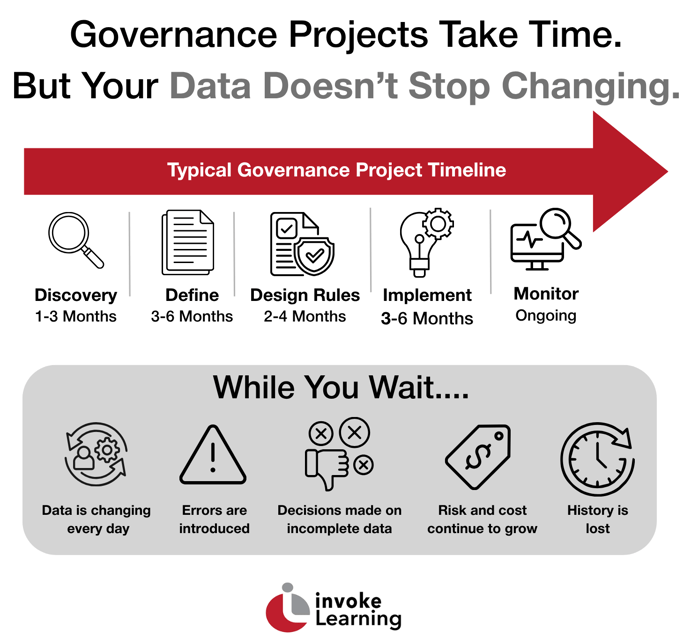
Why Data Snapshotting Is the First Step
Before you govern your data, you need to understand it. That starts with comprehensive data ingestion and daily snapshotting across all your systems.
With daily snapshots, institutions gain:
|
Full Data Visibility |
See what data you actually have, across ALL systems, not just what you assume exists |
|
Historical Context |
See how data changes over time- when did a value change, what did it look like before, how often do corrections occur? |
|
Data Quality Insights |
Identify errors, inconsistencies and patterns as they happen |
|
Informed Governance Decisions |
Build governance policies based on REAL data behavior- definitions reflect actual usage. Policies are based on evidence not assumptions |
Why This Matters Now
While governance initiatives are underway, your institution is still generating valuable data every day.
If you’re not capturing it:
-
- You’re losing insight into how your data evolves
- You’re missing opportunities to improve outcomes
- You’re delaying meaningful analytics and AI initiatives
Time spent waiting for “perfect governance” is time lost.
How Invoke Clarity Changes the Approach
Invoke Learning's data lakehouse enables institutions to:
-
- Ingest data from all major systems (currently have 70+ connectors)
- Automatically caputure daily historical snapshots of all data, not just changes
- Preserve every data change over time
- Begin analyzing and understanding data right away
This approach allows you to:
-
- Understand your data before governing it
- Identify issues early and before governance is finalized
- Apply governance rules retroactively
- Impact Students Faster
Build Governance on Reality—Not Assumptions
Data governance is critical and it should be informed by actual data, not guesswork.
Because at the end of the day:
You can’t govern what you don’t know.
Start by capturing everything. Then govern with confidence.
-1.png?height=200&name=What%20Happens%20when%20A%20Key%20Engineer%20Leaves%20(1)-1.png)
.png?height=200&name=FREE%20YOUR%20DATA%20(1).png)